Editor’s Note: This artist profile is part of a statewide series highlighting Tennessee artists participating in Ars Gloria, a visual arts initiative presented by the Tennessee Press Association and the Tennessee Art League. Follow Ars Gloria on Facebook and Instagram for additional artist features, competition news, and updates throughout the year.
Periodically, art lovers may see visual art likened to some kind of portal to a new world. Art can carry someone somewhere unfamiliar, transforming the viewer by granting a new perspective.
But what of those who bothered to open such a portal in the first place? How does each act of creation transform them, helping them see things anew or make greater sense of the world?
For Nadine Shillingford, creating art is not merely a way of transporting others. It is a means of going somewhere herself. An information technology specialist by day, Nadine operates in a heavily structured, rule-bound, and precise world. Sitting in front of up to four monitors at a time, she works as a cybersecurity data analytics engineer.
There can be excitement in protecting information and preventing data breaches. But the highlight of her day may come after she has logged off from her workstation.
Because that is when the sketchbook, charcoal pencils, and pastels come out. And with those tools in hand, Nadine enters a world governed less by systems and protocols than by instinct, expression, and discovery.
“I like what I do, and I went through a lot of school to get where I am,” Nadine says. “But I would love to make art full-time because that is where I become rejuvenated. That is where I find peace.”
When she is making art, the obligations and banalities of the outside world begin to fade. Hours can pass without her paying much attention to anything beyond the work in front of her.
This includes appetite.
“I can work on art for hours and not notice that I’m hungry,” Nadine says. “If I’m sitting in front of my day job, I might eat the whole house because the work is sometimes not as fulfilling as making art.”
It is an appropriately unpretentious explanation from an artist whose practice becomes increasingly difficult to describe as a hobby.
Various Misadventures
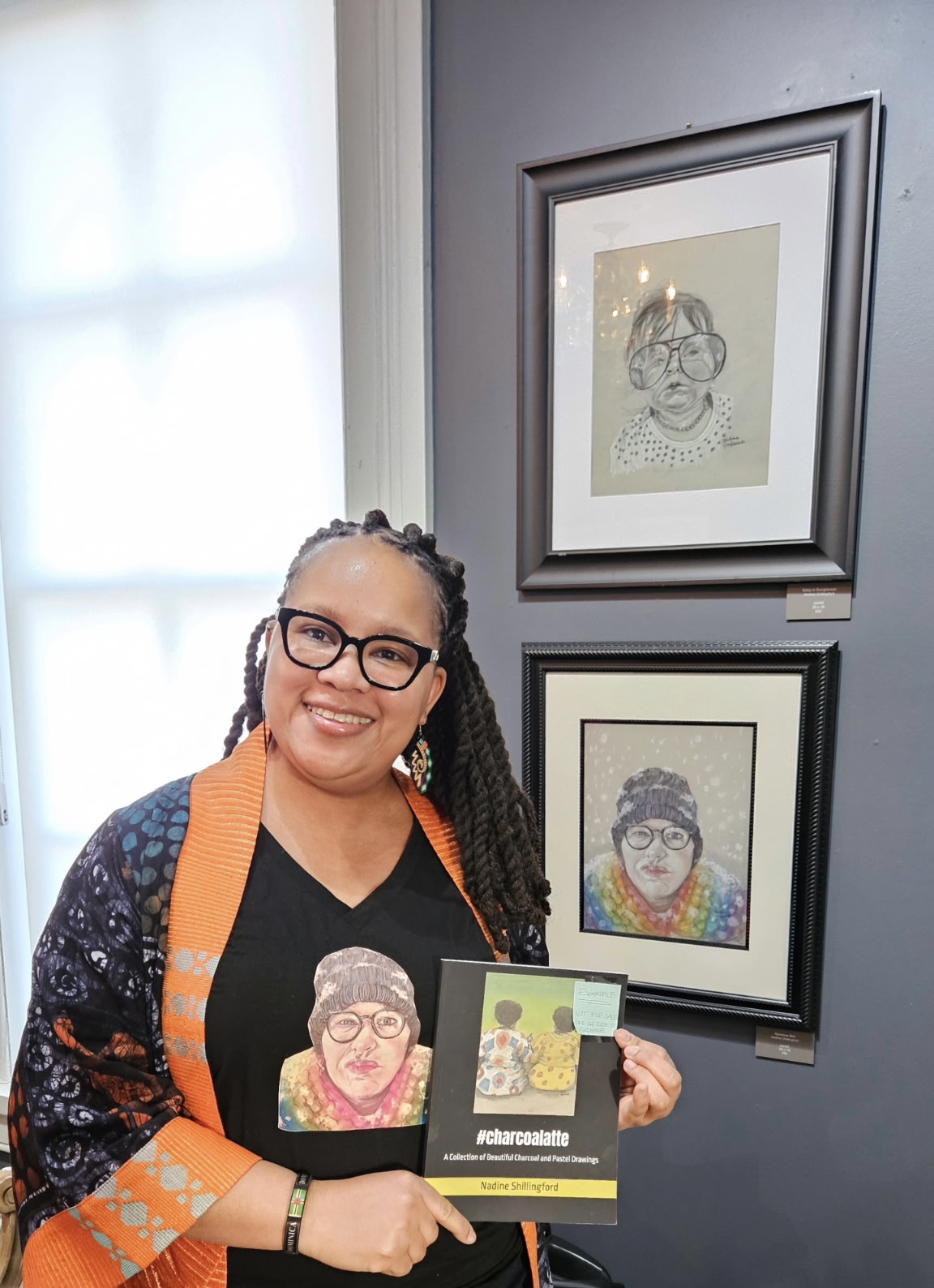
Working under the name Charcoalatte, Nadine has steadily made herself a presence in Middle Tennessee’s visual arts community through exhibitions, art markets, competitions, classes, and technique demonstrations.
Her work has appeared at venues including Cheekwood, GEODIS Park, the Customs House Museum & Cultural Center, and Centennial Art Center, while organizations such as Arts Bellevue, Art & Soul, Downtown Artists Co-op, and Tennessee Craft have selected her work for exhibitions and juried shows.
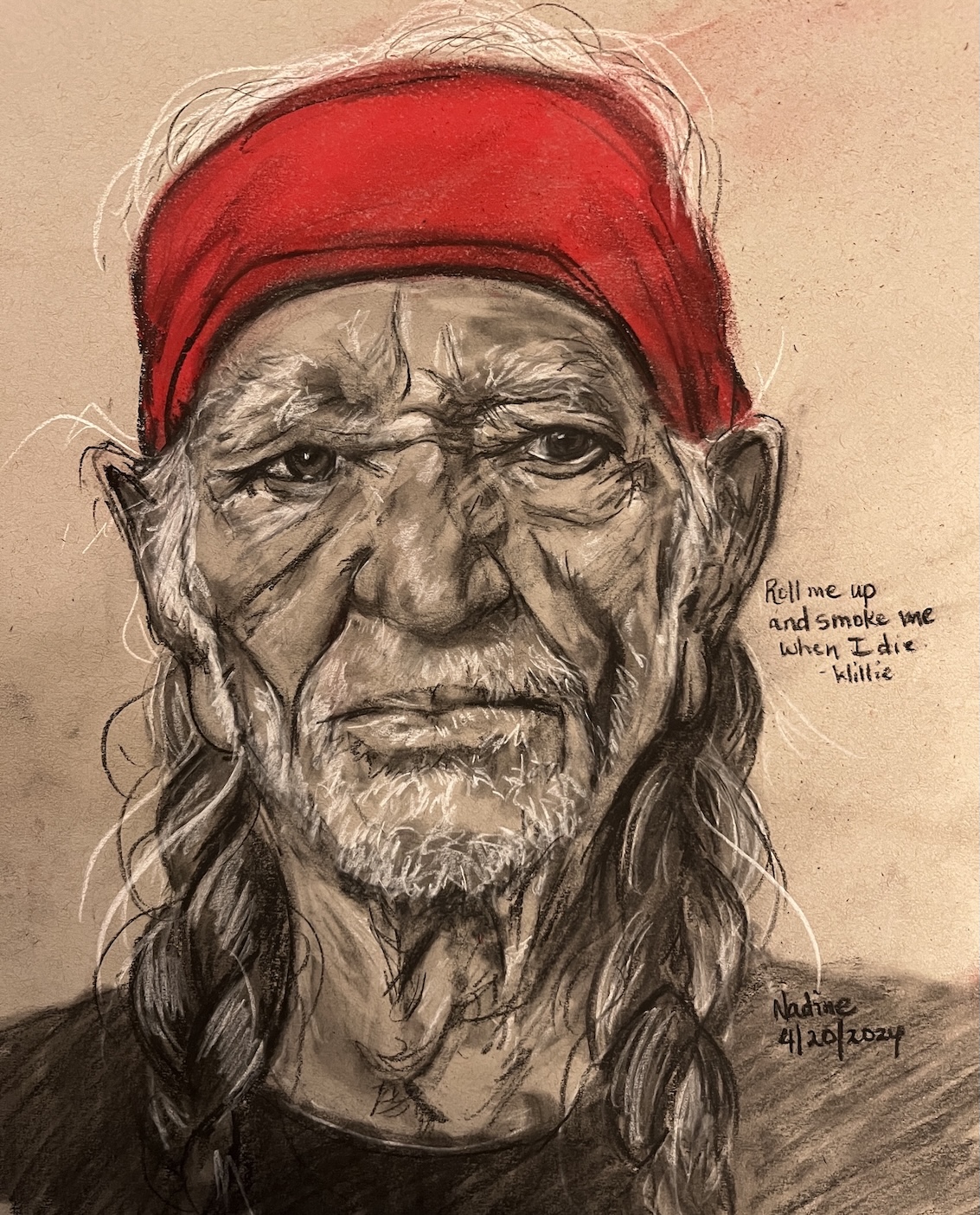
Along the way, those “various misadventures” have started producing more tangible forms of recognition. Nadine earned second place at the 2023 Williamson County Fair and received a scholarship from Tennessee Craft. At a Downtown Artists Co-op exhibition in Clarksville, her mixed-media work “Pixelated Pose” received first place, while a portrait of Willie Nelson took second place in drawing.
Taken together, the exhibitions, awards, and invitations suggest something more substantial than a pastime squeezed in after work. What began as a source of escape and replenishment has gradually become a second professional identity.
And the practice behind all of it is still surprisingly young.
“I define myself as a charcoal portrait artist who occasionally dabbles in mixed media. I’m self-trained. I’ve taken a few community classes, but most of my work has developed through trial and error,” Nadine says.
What the Sketchbook Keeps
There’s a moment in her timeline—somewhere around March 2019—when Nadine says she got serious about her practice as a charcoal artist.
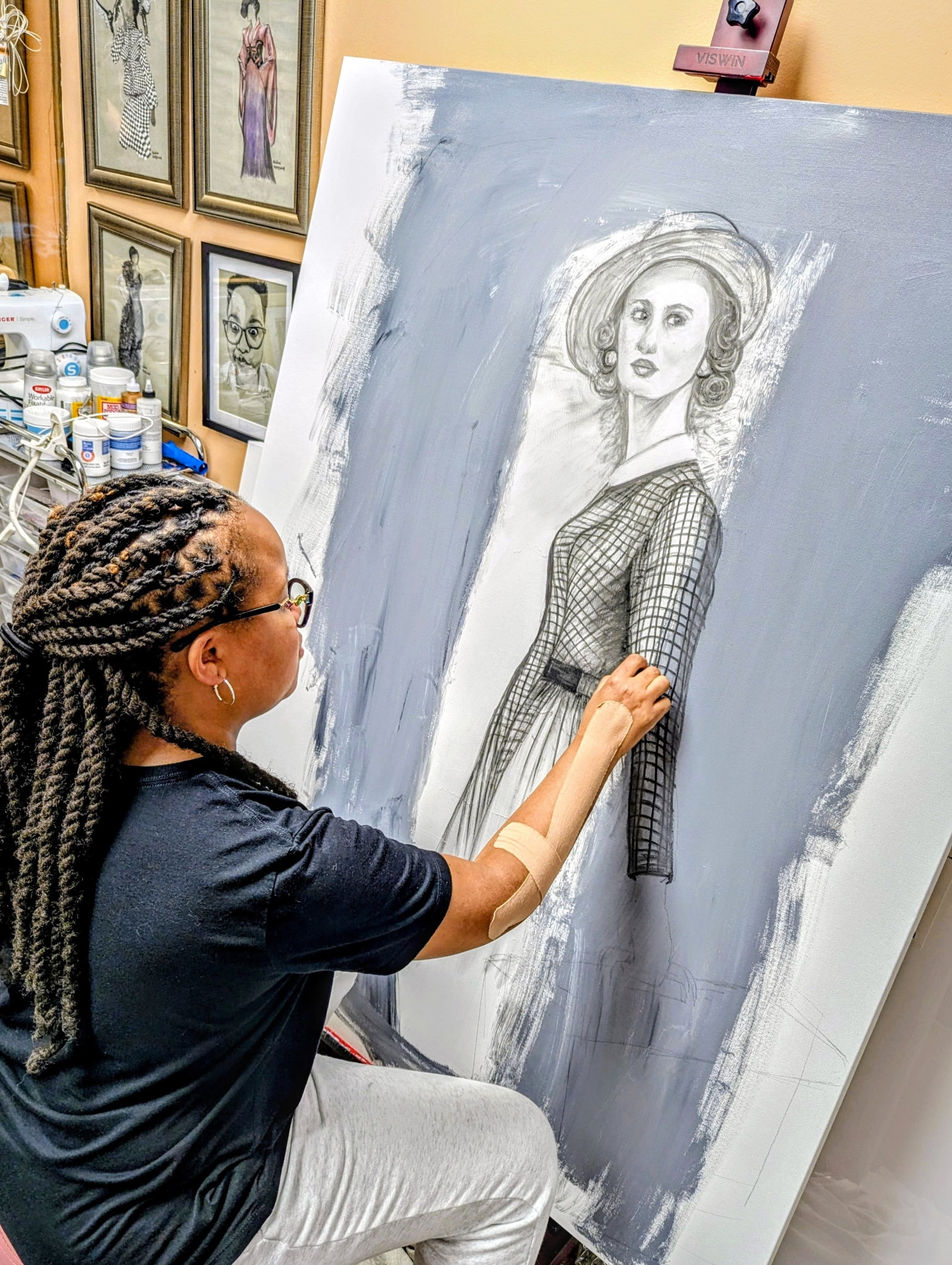
Before then, she experimented with acrylic and graphite, treating art partly as a fun distraction. After March 2019, Nadine began drawing consistently. Repetition trained her eye and hand; recurring mistakes became past mistakes, and fear was dismissed by curiosity.
Since that period, Nadine has drawn almost daily. She regularly starts and completes a drawing within two to three hours.
But if one were to spend enough time scrolling through her work, they would notice a pattern beyond the progression of Nadine’s talent: Her portfolio becomes a chronology of what’s going on in her life. Just like a diary.
“If you look through the last six years of my work, you can see what was happening in the world and in my life at different moments,” she says. “I may not say so directly in the social-media post, but a drawing might be an expression of sadness, happiness, a beginning, or an ending.”
Some moments are more intimate, while others are expressions of political or philosophical ideas. And occasionally, they’re moments that show Nadine’s imagination has been captivated by recent headlines.
Case in point: In 2025, after a pet zebra famously got loose in Middle Tennessee, Nadine’s neighbors challenged her to draw it. Nadine graciously accepted the challenge, and her creativity soon prompted several questions: Why was the zebra running? Where did it think it was going? And what was it trying to escape?
So Nadine invented an explanation. In her version, the zebra—a feminized version of the actual male, who was named “Ed”—believed that she was headed for the glamour of downtown Nashville. Finding herself stuck in Murfreesboro with nary a pedal tavern or country music artist in sight, she became disappointed with her surroundings and decided to make a break for it.
To Nadine, this challenge illustrated something: Drawing and writing are not unconnected activities. And the inspiration for one can trigger inspiration for the other.
“I have loved writing for a long time,” she says. “One of my favorite things is creating a story based on something I drew.”
But the same imaginative instinct has also helped Nadine navigate much heavier territory. At times, it has offered a way back into parts of her life that were harder to revisit.
Reflecting on the passing of her father in 2017, Nadine shares that she began drawing him in pencil. She also wrote stories based on important memories of their time together, sometimes reconsidering events from his imagined perspective.
Now a parent herself, Nadine says those stories helped her bridge the gap between how she understood her father as a little girl and how she sees him today.
“He was very strict,” she says. “But after sitting with those memories and writing through them, I could see that he must have been struggling too. He was raising three girls and one boy and had his own burdens.”
Those stories eventually became a book. “Writing is therapeutic for me,” she says, speaking of the experience.
Facing the Art
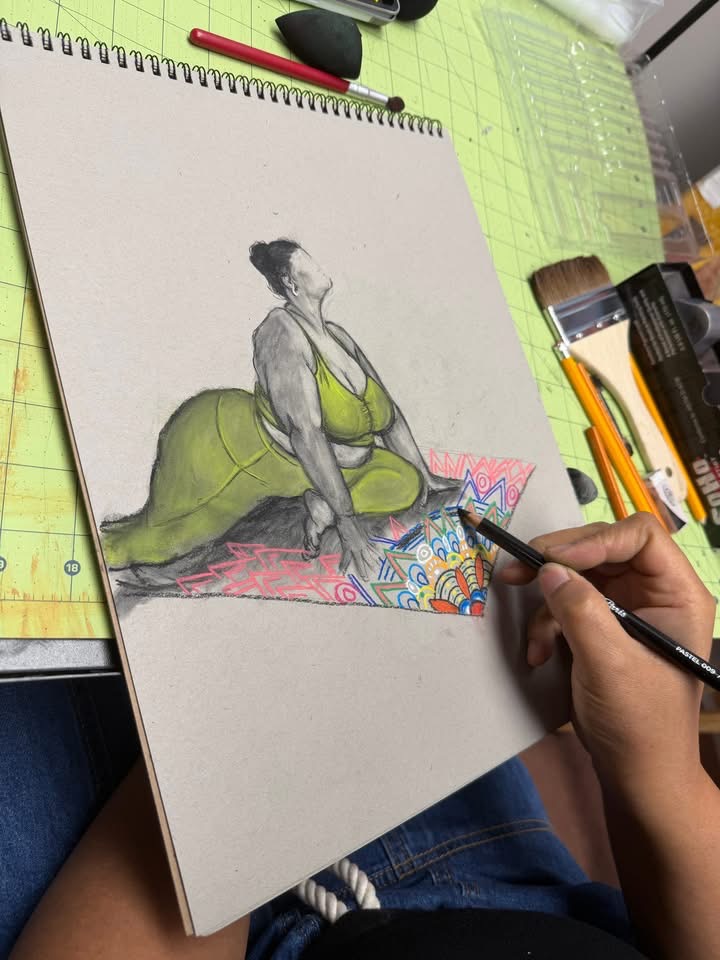
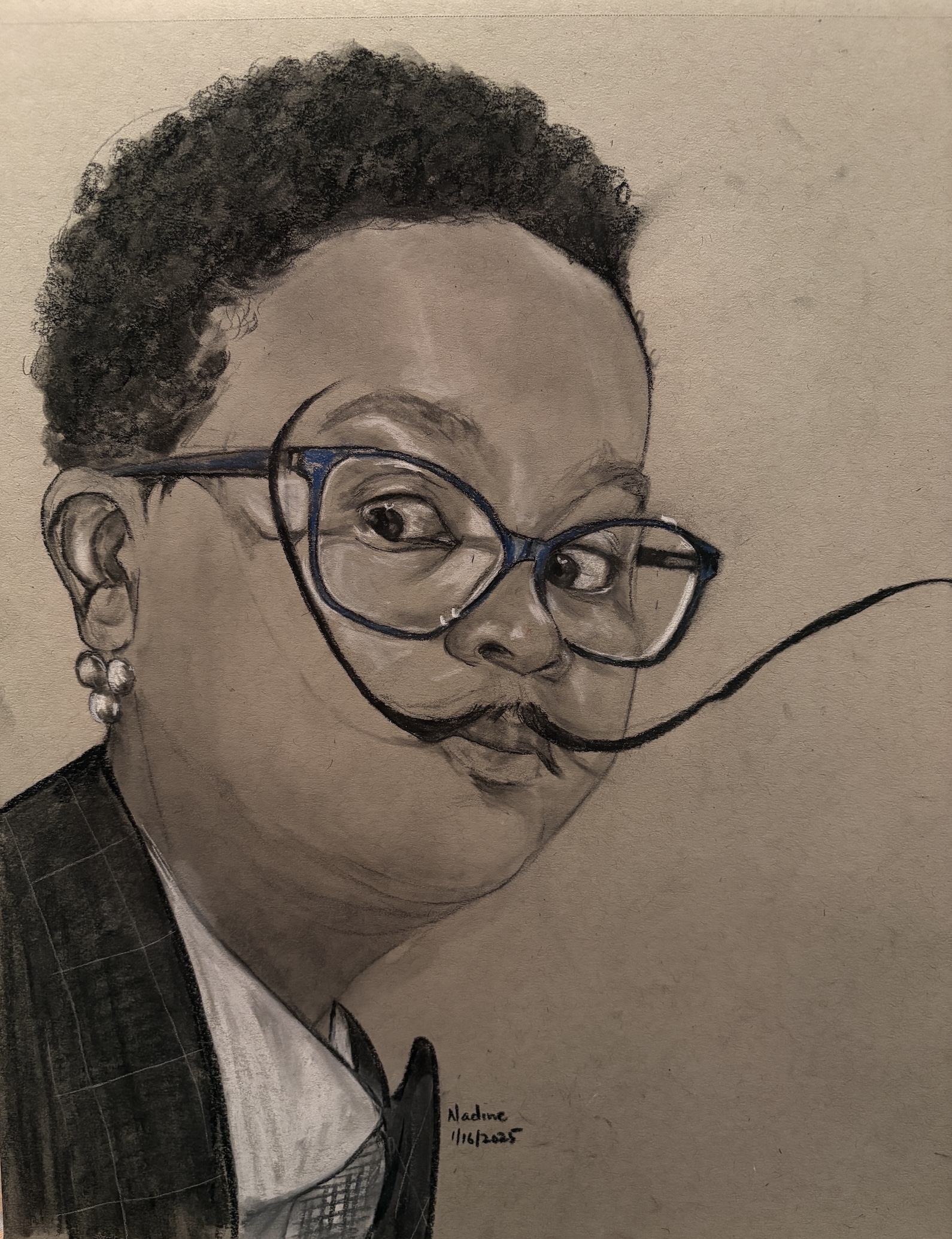
Portraiture remains the center of Nadine’s visual practice. But her finished work rarely stays confined to charcoal alone. Some drawings are almost entirely monochromatic. Others erupt with vivid color and detail—flaunting pinks, yellows, reds, and blues alongside patterns, cloth, found materials, and pastels.
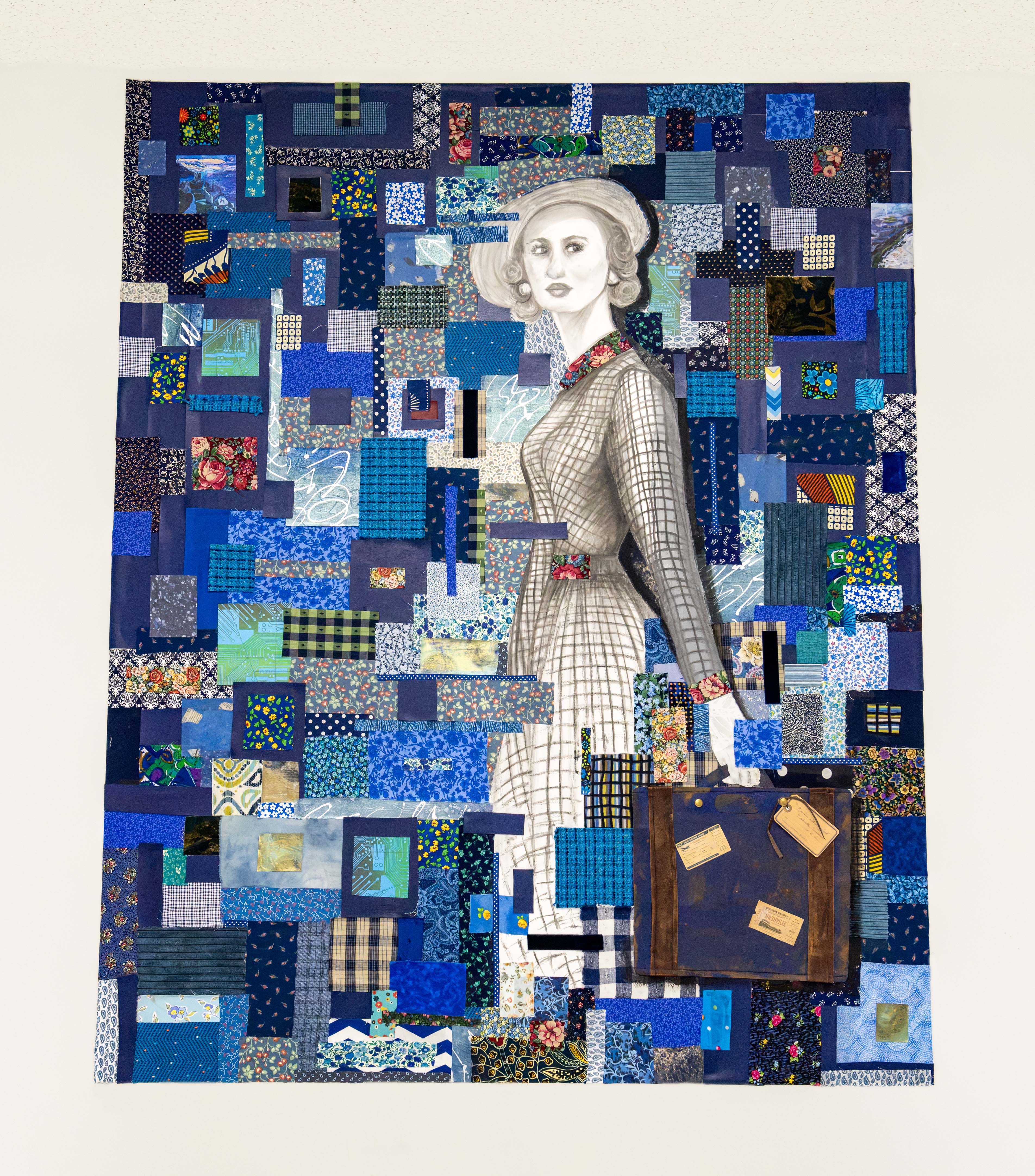
The result can push well beyond the expectations of a conventional drawing and into something more expansive. At times, Nadine’s mixed-media work goes further still, incorporating reproductions of her drawings into much larger collages.
She traces some of her inclination toward these vibrant decisions to her Caribbean upbringing. Nadine shares, “Everything is bright and colorful there, even the houses. I may add strong color to a subject’s clothing.”
At the same time, she is perfectly happy to abandon color entirely when the mood calls for it. “There is not always a clear rhyme or reason behind it.”
Whatever creative direction she decides to take, Nadine always wants viewers to arrive at the subject’s face. It is there that personality tends to reveal itself most clearly, with expression and especially the eyes carrying much of the subject’s character.
“People often tell me that the faces—especially the eyes—look alive, and that is what I strive for,” she says.
As far as Nadine’s art goes, realism stops well short of photorealism. She wants marks to remain visible. And in some pieces, a highly rendered face gives way to hair, clothing, or surroundings that appear loose or even unfinished.
Curiously, part of that aesthetic grew out of fatigue.
When Nadine first established her nighttime drawing routine, she often had about two productive hours before becoming tired. She concentrated her energy on the facial features and left less essential areas unresolved.
Eventually, she converted this limitation into a hallmark of her style. Her technique followed suit.
“When I’m drawing someone’s face, it feels like applying makeup with charcoal and pastel,” she says.
So she uses makeup sponges.
“I don’t know how many other people work that way, but I tried it, liked it, and kept doing it.”
Trial and error, after all, is considerably cheaper than waiting for permission.
A Sketchy Process
Nadine’s attachment to charcoal began with neither artistic philosophy nor grand aesthetic theory.
Instead, it was convenience.
When her daughter was younger, Nadine wanted to make art without removing herself from family life. Acrylic meant setup and cleanup. Charcoal required a sketchbook.
“If we were watching television or she was doing homework, I could get my sketchbook and pencils and draw on the couch,” she says. “I was still right there with her.”
Eventually, practicality became something more tactile.
Since 2019, Nadine has frequently used toned-gray paper with charcoal pencils and pastel. She still remembers adding white pastel to black charcoal on the gray surface for the first time.
“I remember how it felt,” she says. “It felt good, and I kept doing it.”
The medium carries consequences. Charcoal smudges. Heavy pressure can leave marks that refuse to disappear. Paint may permit an artist to cover a mistake; charcoal can memorialize one.
“You almost have to plan ahead before putting the pencil down,” Nadine says.
She finds the medium better suited to portraiture than landscapes or botanical subjects requiring subtle tonal variations.
But when Nadine needs to work bigger, she has another solution.
She cheats.
Or, more accurately, she collages.
Rather than enlarge her usual 11-by-14-inch drawing process, Nadine reproduces images and incorporates them into larger mixed-media compositions. “Framed Beauty,” for example, combined prints of female figures, reused materials, and actual frames.
“The challenge is arranging the images so each one can still shine, even with all the additional material,” she says.
That eclectic approach also helps explain Charcoalatte, a name supplied by her sister Ann around 2019 or 2020.
“A latte is coffee, but it is not only strong coffee; it has other things mixed into it,” she says. “Charcoal is my primary art form, but I supplement it with other media.”
By now, people know the name. She sees little reason to change it.
The Art Goes Before Her
Nadine came to the United States from the Caribbean for graduate school, later completed her doctorate at Notre Dame, taught at Rose-Hulman Institute of Technology, and eventually moved to Tennessee for a career in cybersecurity.
Her Nashville artistic community began almost accidentally. While working across the street from Centennial Art Center, Nadine walked inside during lunch and eventually began taking classes. The people she met became some of her first friends in Nashville.
From there, the circle widened, most recently to Michael McBride’s M & M Studio.
Her explanation for becoming so involved in Nashville’s art scene is simple: join things, meet people, remain open, and show up.
“It is my social life,” she says. “If I had to describe myself, I would say: I go to art shows. There is not much more than that.”
There is, of course, considerably more than that.
Somewhere amid those exhibitions, Nadine discovered that the artwork was changing its maker.
“Art has made me braver,” she says. “I do not hide as much.”
Professional environments—particularly technology—have not always produced that same confidence. Art does something different.
“When I’m in an exhibition, simply having my art there gives me confidence,” she says. “It is almost as though my art goes before me. I do not have to put on a show because my art is already doing it.”
Recognition matters, but Nadine places surprisingly little emphasis on trophies. A stranger telling her that a drawing made them laugh or stayed with them can mean more.
“Prizes are things you apply for,” she says. “But when someone tells you that a particular piece touched them or made them laugh, that is where I get the most satisfaction.”
Beneath all of this lies something quieter.
When Nadine was younger, she sometimes wondered what trace of her life would remain after she was gone.
“If something happened to me today, would people remember who I was?”
She no longer asks the question in quite the same way.
Her work has traveled farther than she has. Pieces have been purchased as far away as Poland. Others have hung before people who may never know Nadine personally.
“The fact that the work is out in the world means someone will remember me,” she says.
It is a striking declaration from someone who still describes art, at least partly, as a hobby.
Six years of almost-daily drawings tell another story.
They document people she loves, things that irritate her, things that make her laugh, grief she has survived, political moments she felt compelled to answer, experiments that worked, mistakes that did not, and ordinary evenings when a woman finished staring at four computer screens and reached instead for charcoal.
Taken together, they form something larger than a portfolio.
They are evidence that Nadine Shillingford was here.
For further information about the work of Nadine Shillingford, visit her website and social media.