Editor’s Note: This artist profile is part of a statewide series highlighting Tennessee artists participating in Ars Gloria, a visual arts initiative presented by the Tennessee Press Association and the Tennessee Art League. Follow Ars Gloria on Facebook and Instagram for additional artist features, competition news and updates throughout the year.
To Nashville artist Sharon Harms, still life is anything but lifeless. And each object found on one of her canvases is brimming with vitality and meaning.
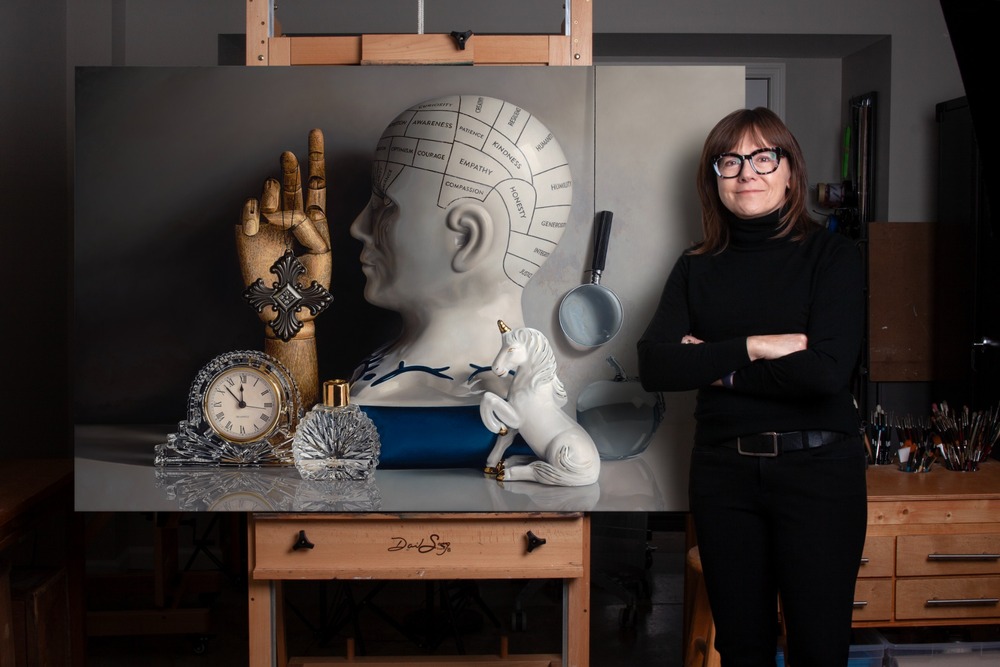
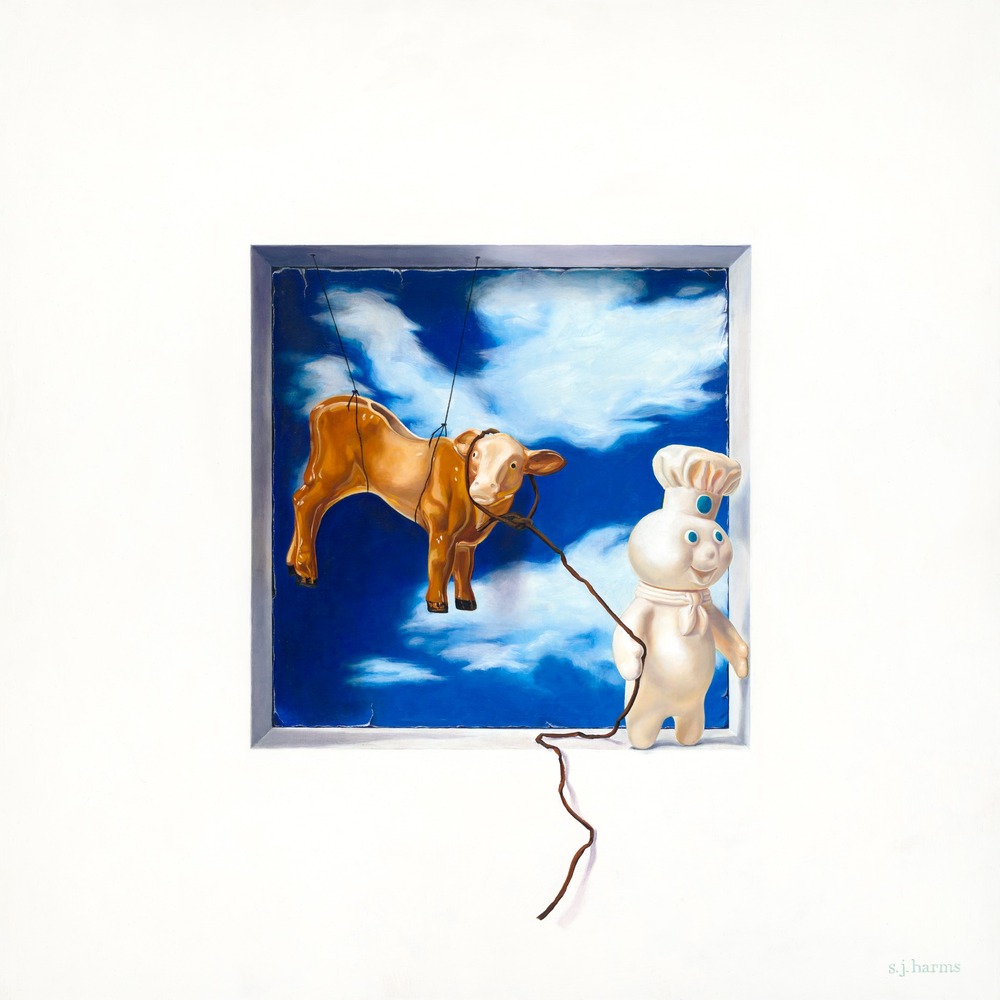
“My art is hyperrealistic, narrative still life,” she explains. “It’s a response to the symbolism that I see in man-made objects that people interact with.”
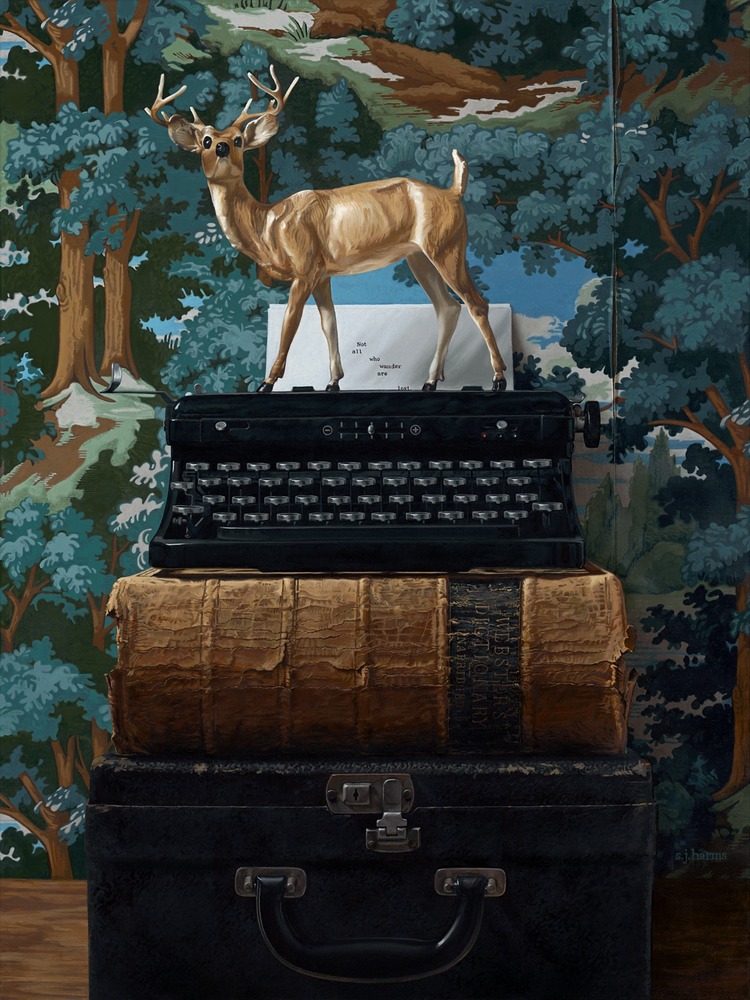
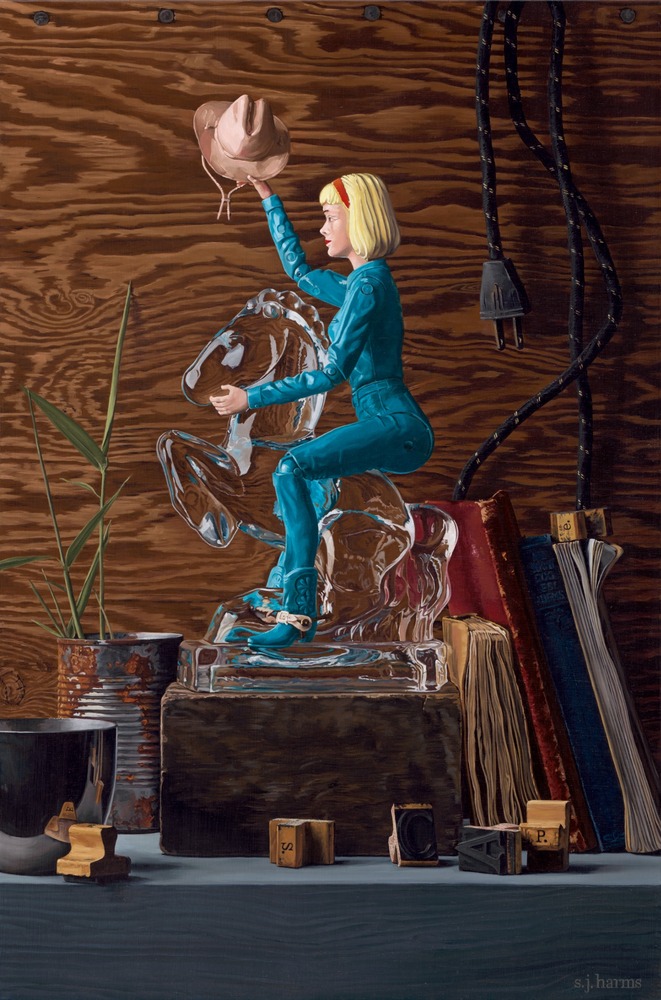
Those objects can include anatomical models, vintage toys, typewriters, glass figurines, and advertising ephemera. Sharon gathers them without a specific story in mind, responding instead to symbolism, memory and an instinctive sense that certain things belong together. Every composition begins with an object that captures her curiosity, something that seems to have more to say than its surface suggests.
As other objects are added, connections appear, and unexpected stories begin to emerge. “I’m a visual storyteller,” Sharon says. “And that comes from my graphic design background.”
A Designer from the Beginning
That background stretches back more than half a century. Raised in rural western Michigan, Sharon could draw accurately from an early age. One of her earliest artistic fascinations came from her family’s “Golden Book Encyclopedia Set.” The covers featured still-life illustrations with a trompe l’oeil quality.
“When I was eight or nine years old, I used to just stare at those encyclopedias,” she recalls. “I couldn’t get enough of the covers of those books.”
The thought was simple: “Boy, I don’t know how you do this, but I sure would like to learn!”
At ten or eleven, she made pop-up greeting cards, gluing items inside so that objects emerged when the card opened. “There was always this designer and maker in me,” Sharon says. “I was one of those kids who said, ‘I can do that!’”
By sixteen, that instinct had become a profession. In 1973—while still in high school—Sharon received an opportunity to apprentice at a graphic design studio for class credit. She never really left the industry.
She graduated at seventeen and later enrolled part-time at Kendall College of Art and Design in Grand Rapids. Without money or family support, Sharon lived at the YWCA, eventually becoming weekend manager of a facility housing people dealing with homelessness, addiction, and domestic abuse.
Even there, however, her design education continued. Friends from school helped Sharon turn the YWCA basement into a makeshift studio, and before long they were coming to her for instruction.
“I had already been working in graphic design and art direction for three years at this point,” she says. “And I knew a lot of technical things that the other kids weren’t really being taught at the school.”
Sharon might have anywhere from three to ten students gathered around a table while she worked, critiqued their projects, and showed them techniques.
Eventually, unable to afford tuition, she left school after one year. “I thought if I was qualified to teach, I don’t know that I need to go to school!”
Sharon thought of herself less as an artist at the time than as a visual designer. “It might sound arrogant to say this, but I always felt that I just knew how things should look.”
Her original dream had been architecture. She comes from a family of engineers and says she has often thought more like one herself. “I think I’m a hybrid of different abilities in many ways.”
That combination of artistic instinct and technical thinking would continue to shape her career.
The Discipline of Design
In 1977, Sharon returned full-time to the design studio where she had started. Roughly a year later, she left Michigan for Denver with $200, a van, and no contacts.
She lived out of the van briefly before finding another design job.
Confidence, she admits, was not necessarily what drove the decision.
“No, I never did!” she says when asked whether she felt prepared. “And I was a little stupid, of course. But it all worked out.”
Graphic design in that era still required drawing ability. Layouts were drawn by hand, and art directors had to communicate ideas visually before finished designs could be produced.
“We used to just sketch everything out,” Sharon says. “All of our layouts were hand-drawn.”
Her career advanced quickly. Sharon eventually joined the Adolph Coors Company’s internal graphic design operation, producing promotional work that reached national and international audiences. Still in her twenties, she rose into a supervisory role overseeing other designers and art directors.
“I started so early that even though I was so young, I was ahead of some of my older coworkers.”
Over the years, Sharon moved through agencies in cities including Cleveland, St. Louis, Miami, and Nashville, along with production work in Los Angeles and New York. Her clients ranged from regional businesses to recognizable national brands, including Coors, Skittles, Twix, and Anheuser-Busch products.
But the size of the client was never necessarily the point. Sharon was interested in working for agencies that wanted “smart advertising that made a connection with the audience.”
The work should be interesting. Artful. Clever. Funny.
“That’s what I tried to develop, and that was the goal I always reached for!”
Smaller agencies also gave Sharon something she valued: autonomy.
She could get to know clients directly rather than being insulated from them through layers of a large organization. “I was a good listener; in meetings, my clients would talk about their brands, and I would immediately start formulating ideas for how to tell their stories.”
That approach eventually became central to the way Sharon understood her profession.
“Advertising should be thought of as a form of storytelling,” she says. “As a designer and art director, it was my job to visually bring the stories to life.”
In advertising, a good visual should pay off the headline. Her paintings now reverse that process. “I paint the visual first and then come up with a title that expands meaning to the piece,” Sharon explains.
When the Client Says “No”
Advertising also taught Sharon what to do when an idea failed.
At one point, she developed a campaign for Edy’s Ice Cream that she loved. Sharon thought the proposed posters and full-color magazine ads were beautiful and believed the campaign could win awards.
The client rejected it. Sharon was devastated and angry enough that she considered walking out. But her writing partner offered another perspective: “Now, you’ve got an opportunity to do something even better.”
The comment stuck. Sharon reworked the campaign into black-and-white newspaper advertising. She says the result was better. It ran regionally, won awards, and ultimately became part of her portfolio.
“Hearing that changed me,” she says of her writing partner’s advice. “A lot.”
She still fights for ideas and maintains strong opinions about what works creatively. But rejection no longer necessarily means defeat. “If you get another chance at the bat, you can probably do something even better if you try.”
That lesson would become particularly important when Sharon finally became a full-time painter.
After moving to Nashville, she worked at agencies including The Buntin Group and Lewis Communications before moving into freelance healthcare advertising. Her clients included HCA Healthcare (HCA) and Vanderbilt Health.
The HCA work grew considerably. Sharon hired designers, a writer, and production personnel while handling video, rebranding, enterprise messaging, and advertising.
By then, she felt decades of experience converging. “It felt like all the experience I had earned had finally paid off when executing these projects.”
But the work was exhausting.
Sharon planned to retire at the end of 2020. Then COVID-19 arrived earlier that year, and HCA indefinitely paused all her projects as healthcare organizations shifted priorities.
She took it as a clean break.
“I knew immediately that it was my chance to go to work in the studio and start painting again.”
Painting had always been part of the retirement plan. Sharon had attempted to pursue it while working, but the advertising business left little energy.
“I would always come home way too tired to pick up a brush.”
When the career finally ended, there was no uncertainty about what came next.
“When I retired, I had no doubt that I was going to start painting again.”
She was entering professional fine art in her 60s, but Sharon did not see herself as beginning from zero.
“In many ways, being older was a huge advantage for me,” she says. “I had a lot of life experience to draw from. It gave me awareness and confidence I didn’t have in my 20s, 30s, or even in my 40s.”
“I feel like I was already a professional artist before I started painting.”
Creating Her Own Box
Still, one unexpected problem emerged.
For decades, clients set the parameters, and Sharon was tasked with solving the creative problems within them.
Suddenly, nobody was providing the box.
“When I first decided to paint for myself, I struggled quite a bit,” she says. “I was so used to working on projects that started with a set of limitations.”
Unlimited possibility was not necessarily liberating.
“When you’re facing endless possibilities, you don’t necessarily see a direction to take that excites you. It’s like everything becomes white noise.”
Constraints, Sharon realized, could be useful.
“You can treat working within parameters like being trapped in a box. Or you can choose to see the parameters as both a filter and a framework.”
Her solution was to create her own.
“As an artist, you really have to know who you are, what you’re doing, what you want to do, and why you want to do it,” Sharon says. “That’s your box. Those are self-inflicted parameters, and you can grow them.”
“That’s much better than just flailing in the wind.”
Where Intuition Meets Precision
Advertising had also given Sharon another habit: rationale.
“I’m more comfortable having a rationale for how I approach painting,” she says.
That rationale becomes clearer when considering the artists and movements that shaped her.
Trompe l’oeil fascinated her from childhood, including the work of Claude Yvel. Sharon is careful to distinguish her paintings from traditional trompe l’oeil, but the idea of creating three-dimensional presence on a two-dimensional surface has always appealed to her.
Later came the photorealists.
Audrey Flack’s large-scale still lifes became particularly influential. Sharon also cites Chuck Close, Ralph Goings, and Richard Estes, whose paintings of reflections in glass made a lasting impression.
“I usually try to represent elements of glass in my work,” Sharon says. “I like the notion that I can make it look transparent and fool the eye.”
Then there is surrealism.
Sharon says she “just can’t get enough” of René Magritte, particularly his ability to tap into the unconscious mind while maintaining precise technique.
“I love how he was able to use dreams and bypass logic but do it with the precision of an engineer or designer,” she says. Her own compositions begin intuitively.
“There’s no agenda,” Sharon says. “It’s all intuition. I let the objects tell me what to do.”
In Sharon’s mind, that intuitive process matters as much as the finished image. This distinction informs her response to critics who question the usefulness of photorealism in an age of ubiquitous photography.
She believes such criticism overlooks artistic motivation. Her goal in painting is to bring “into existence a presence on a two-dimensional canvas” through her own hand.
A loose rendition would not have the same resonance. Nor would simply taking a photograph. “That’s a view that prevents one from looking at art as a personal projection of the artist,” she says.
The final image is only part of what matters. “It’s the pursuit of the art, not just the product itself.”
Sharon describes painting as an intensely focused activity. The process creates a space in which she can remain present with the objects, ideas and associations developing before her.
“I’m taking intangible ideas, symbolism, emotion, and thoughts, and transferring them to the canvas through the objects that I paint,” she says.
“And in that process of giving presence to objects, I’m able to experience intense presence and focus within myself.”
For Sharon, the ordinary object is therefore never merely ordinary.
A still life can contain memory, cultural meaning, symbolism, and fragments of a story that neither the painter nor the viewer necessarily understands just by looking at the individual objects.
“The still life is not an endpoint but a doorway,” she writes in her artist statement. “My work is a space where intuition and precision meet, where the imagined becomes real, and where nothing is simply still.”
Sharon’s work is currently on view at the Customs House Museum through Oct. 22.
Beyond that exhibition, she is already looking toward a more personal body of work. “I am working on a series of paintings that are more personal,” she says. “I want to tell some specific stories from my life. My way of painting is very slow, so I’m also exploring ways to speed up the process. I have a lot of stories to tell.”
For further information about Sharon Harms, visit her website and social media.