Editor’s Note: This artist profile is part of a statewide series highlighting Tennessee artists participating in Ars Gloria, a visual arts initiative presented by the Tennessee Press Association and the Tennessee Art League. Follow Ars Gloria on Facebook and Instagram for additional artist features, competition news, and updates throughout the year.
What happens when a master artist explores new mediums? And what might that new art look like when it’s informed by that artist’s hard-won skills and experiences?
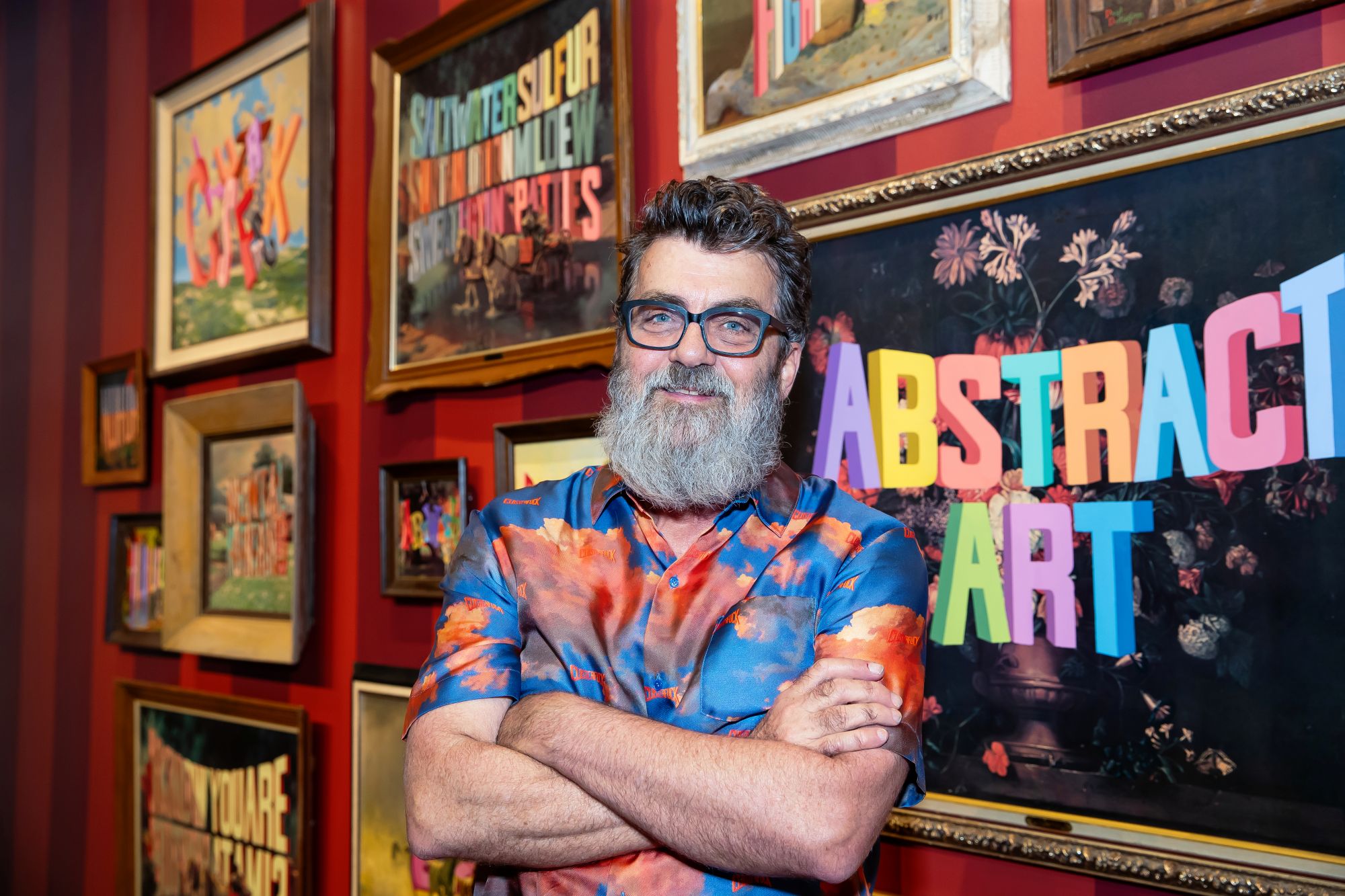
One answer is that it just might look like the work of Wayne White, an award-winning, multidisciplinary artist. Wayne’s singular brand of pop surrealism has been part of beloved TV shows, movies, and music videos. Cascading across different mediums—including illustration, production design, puppetry, painting, and music—his creativity blends together in a way the art world has never seen before.
“That’s the job of the artist,” Wayne explains. “You have to find some kind of angle that’s unique to you. Going through different disciplines gives you that new perspective.”
A Product of the South
Though he now lives in Los Angeles, Wayne’s presence is still felt in the Volunteer State.
“I haven’t lived there since 1981, but I’m a Tennessean,” he declares. “I do a lot of work there, including the big tourist attraction Wayne-O-Rama.”
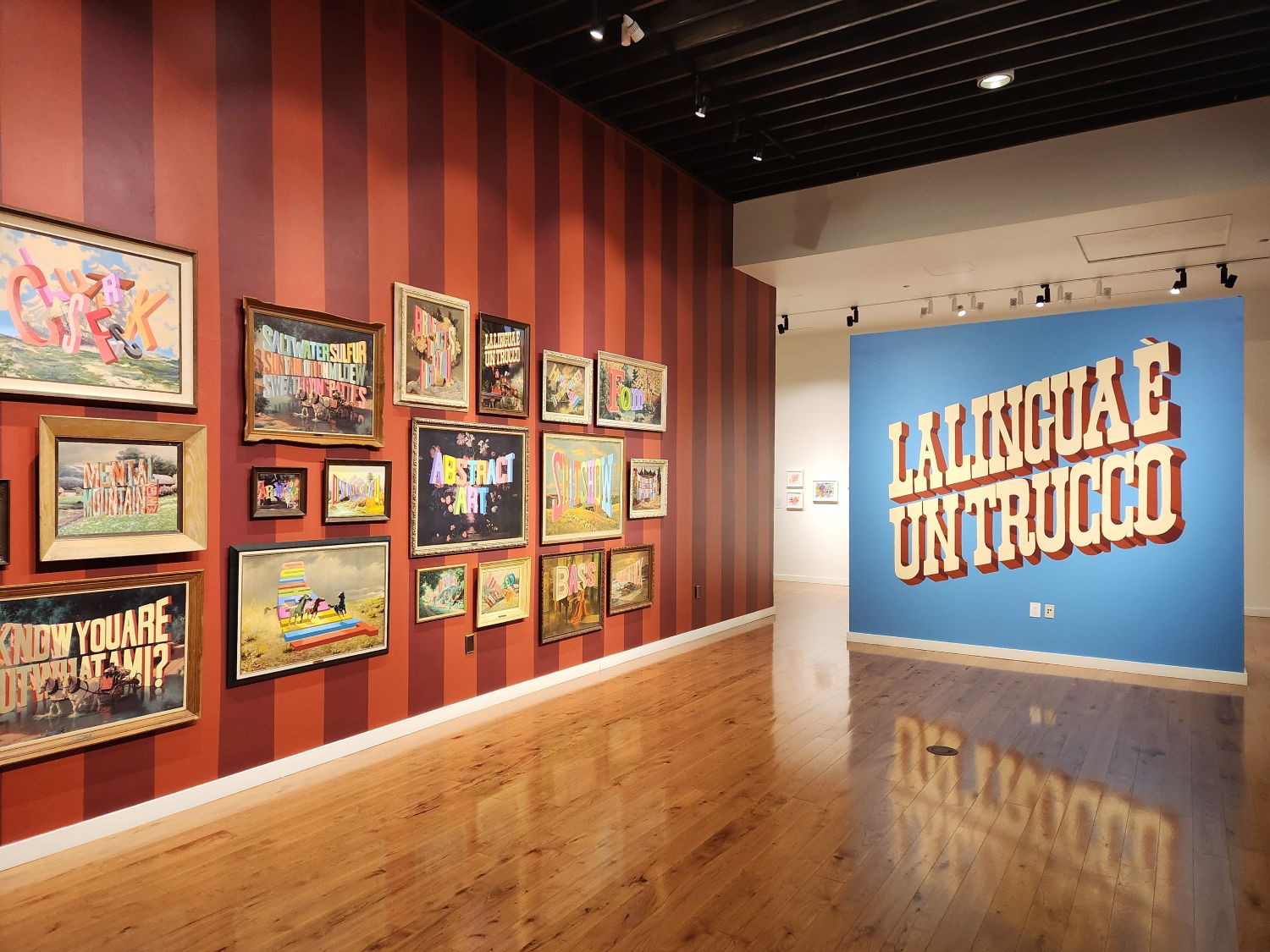
Wayne has also had several solo exhibitions in Nashville and continues returning to Tennessee for other projects and performances. In Knoxville, his 2026 exhibition “Revenge of the Knoxville Girl” opened at the Knoxville Museum of Art during the Big Ears Festival, where he also performed with his band, USERNAME PASSWORD.
Born in 1957, Wayne was raised in a blue-collar household in Chattanooga (Hixson). He credits Tennessee for shaping his identity, sharing that his Southern roots have helped him stand apart from other artists.
As with many artists, his affinity for art began with drawing at a very young age. Those early efforts marked him profoundly.
“Drawing is my life. A line on the page is everything to me. That’s the origin of my soul. It’s one of my first memories, drawing and seeing the reactions of people. It’s like, ‘Oh! This is powerful. It makes the adults pay attention to you!’”
In addition to drawing, Wayne loved reading comic books. His interests in the medium started with Superman, later maturing into the weirder works of artists like R. Crumb. These passions provided Wayne with a much-needed escape from the isolation he often felt as he struggled to fit in. He says that this is an experience too many artists must face.
“We’re a nation of moneymakers who are in survival mode all the time. Our culture doesn’t like art or artists. Americans see art as frivolous, after-hours stuff for kids, rich people, and the leisure class. It’s not viewed as something available to regular, lower-middle-class people,” he explains.
Despite a lack of support from society as a whole, Wayne embraced his interests and decided to become a professional artist. After graduating from high school in 1975, he moved to Murfreesboro to attend Middle Tennessee State University (MTSU).
There, he majored in art, concentrating in abstract expressionist painting. “Abstract painting is still a big part of my artistic vocabulary,” Wayne says.
Wayne enjoyed his time at MTSU, likening it to an endless art party. As a junior, he started making puppets from Styrofoam and cardboard to perform “punk rock puppet shows”—complete with fake blood, vomit, and pyrotechnics—in different spaces. His friends discouraged him, however, begging him to focus on his illustration and painting.
Earning his degree in 1979, Wayne moved to Nashville. While in Music City, he discovered Art Spiegelman’s avant-garde comics magazine “Raw.”
“After that, I moved to New York City to be around Art Spiegelman and the world that he was creating,” Wayne recalls. “That was my impetus. I thought for a while that I was going to be a cartoonist.”
In New York, he took one of Spiegelman’s classes on making cartoons at the School for Visual Arts. He took a job as a cook at the Empire Diner to pay his bills. However, life in NYC turned out to be more stressful than he could handle, and he ultimately failed in his coursework.
Still, Wayne wasn’t taking Spiegelman’s class for a grade. He was taking it to learn. Continuing to draw and do his puppet shows in galleries and apartments, he honed his craft for three years. Finally, the alternative paper East Village Eye noticed his work, hiring him to do comics.
“I’ll Be a Big Noise…”
Wayne’s comic career was taking off, albeit slowly. Despite all the twists and turns, he was getting steady work for a variety of publications such as The New York Times, The Village Voice, High Times Magazine, and even Raw, which had brought him to the Big Apple in the first place. This work led to an even bigger benefit. It was through the world of underground comics that Wayne met his future wife, Mimi Pond.
In 1985, while working in New York and continuing to do puppet shows, a friend back in Nashville contacted Wayne. Now working for a PBS affiliate, she shared that the station was looking to do a music-based children’s program. Wayne applied for a job on the program—“Mrs. Cabobble’s Caboose”—and was hired. As a result, Wayne returned to Nashville to work as a production designer and puppetmaker.
Sadly, the program’s production was short-lived. But it gave Wayne enough professional work samples to warrant putting together a portfolio. Later, in 1986, Wayne returned to New York to apply for work with the production company Broadcast Arts (BA). Wayne’s portfolio impressed the BA team, and he was hired right away to work on “Pee-wee’s Playhouse.” Wayne would work as a production designer, puppetmaker, and puppeteer for the show, voicing such characters as Randy and Dirty Dog.
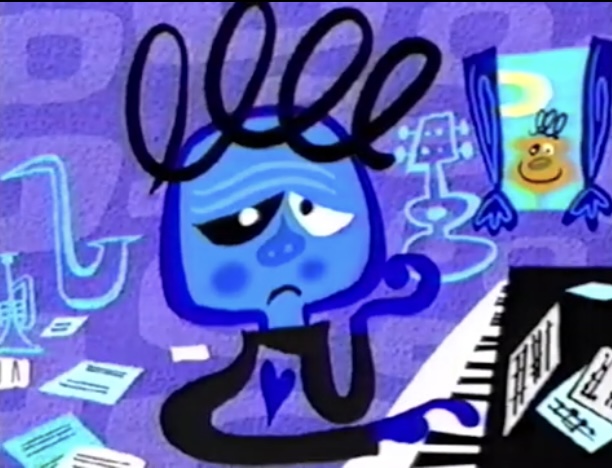
Playhouse would turn out to be Wayne’s dream job. Equal parts national TV broadcast and experimental art project, the show—which felt like a child’s drawing brought to life—was an international sensation.
Recounting the experience, Wayne says, “Well, the first season of Playhouse was a painful birth. But when we finally got it up and running, it was a joy. I was the luckiest guy in the world to work on that show.”
His good fortune continued later that same year, when he was hired to work on the music video for Peter Gabriel’s smash hit song “Big Time.” Doing puppets, production design, and animation, he earned both an MTV Video Music Award and a Billboard Award for this video.
In 1987, Wayne and Mimi relocated to Los Angeles to follow the production of Playhouse, which had moved to LA. That same year, he won a Daytime Emmy Award (“Outstanding Art Direction/Set Decoration/Scenic Design”) for his work on the show.
Wayne stayed with Playhouse, which was now earning numerous awards. In 1989, he found additional production design work for “Shining Time Station,” another beloved children’s show that would be remembered years later.
Production on Playhouse would conclude in 1990, ending a short era of creative magic for children’s television. Discussing the show’s awards, Deadline states, “Over the course of its original five-year run on television, Pee-wee’s Playhouse garnered 22 Emmys, a Parent’s Choice Award, a TV Critics Award, and numerous other honors and accolades.”
Changed by what the show had done for him, Wayne would leave the show with three Emmys and cult fandom forever attached to his name. He would continue working on “Shining Time Station” until its conclusion in 1993, finding work in the coming years on other programs like “Riders in the Sky,” “Beakman’s World,” and “The Weird Al Show.”
“Of course, in the middle of this, my wife and I decided to have our kids Woody and Lulu,” Wayne says. “We joke that they were the ultimate art project.”
Separately, he would work on The Smashing Pumpkins’ whimsical music video for “Tonight, Tonight,” which earned him an MTV Video Music Award.
…Worth a Thousand Words…
By 2000, Wayne was burned out by the industry. Uninspired and disillusioned, he tried to reignite his creativity by diving back into visual art.
“I wanted to get out of television bad,” Wayne recalls. “And I wanted to be an artist. That was always the dream.”
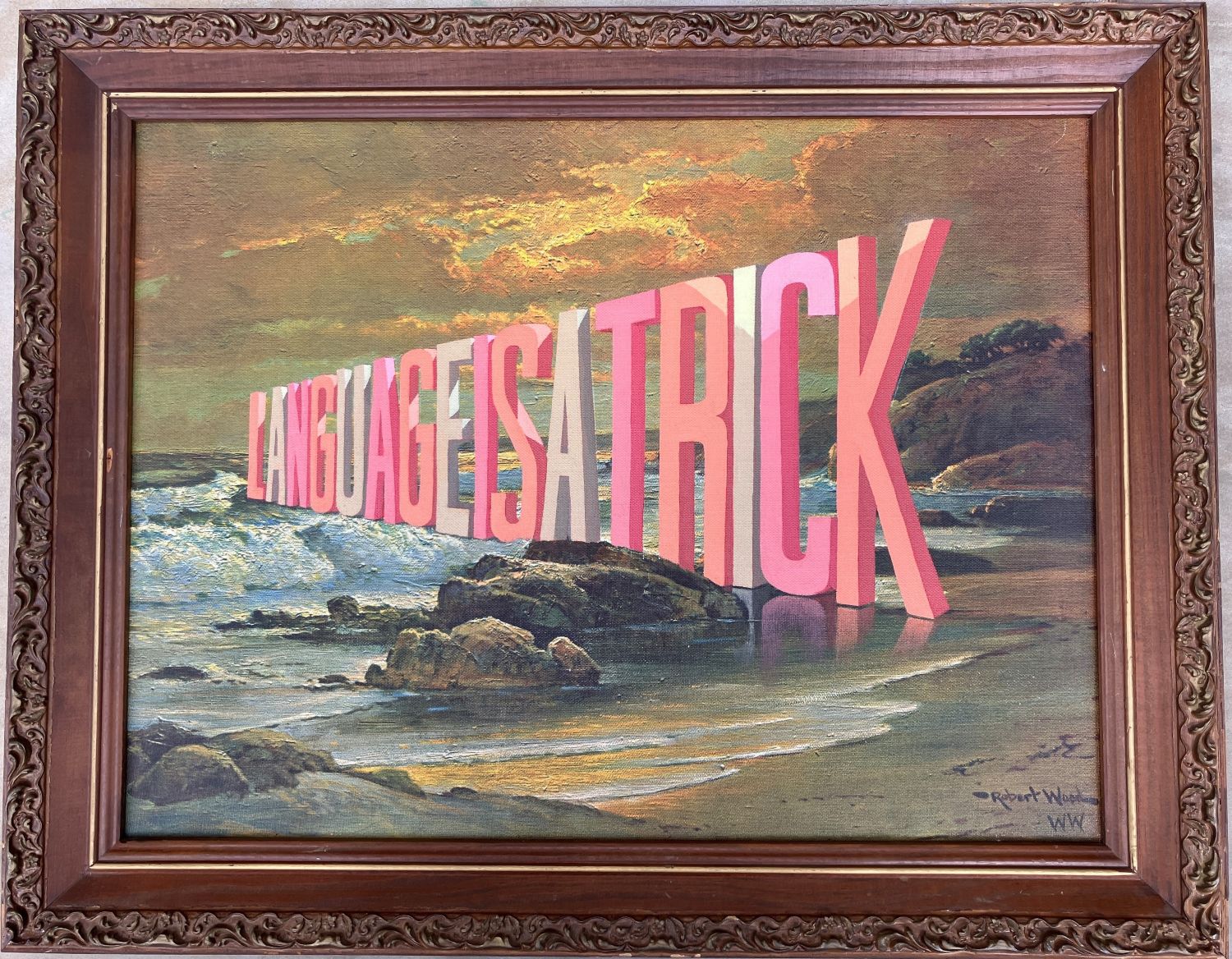
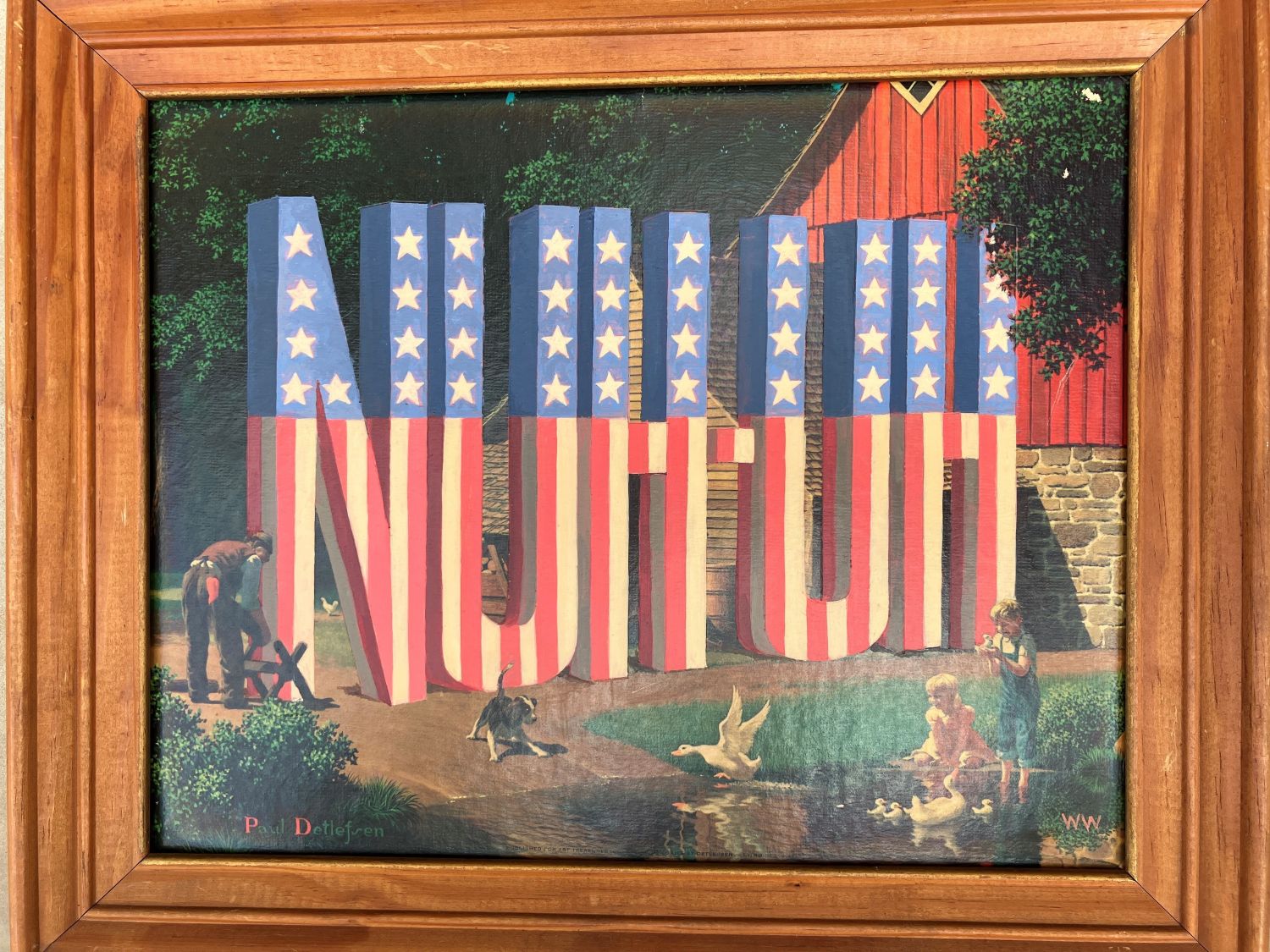
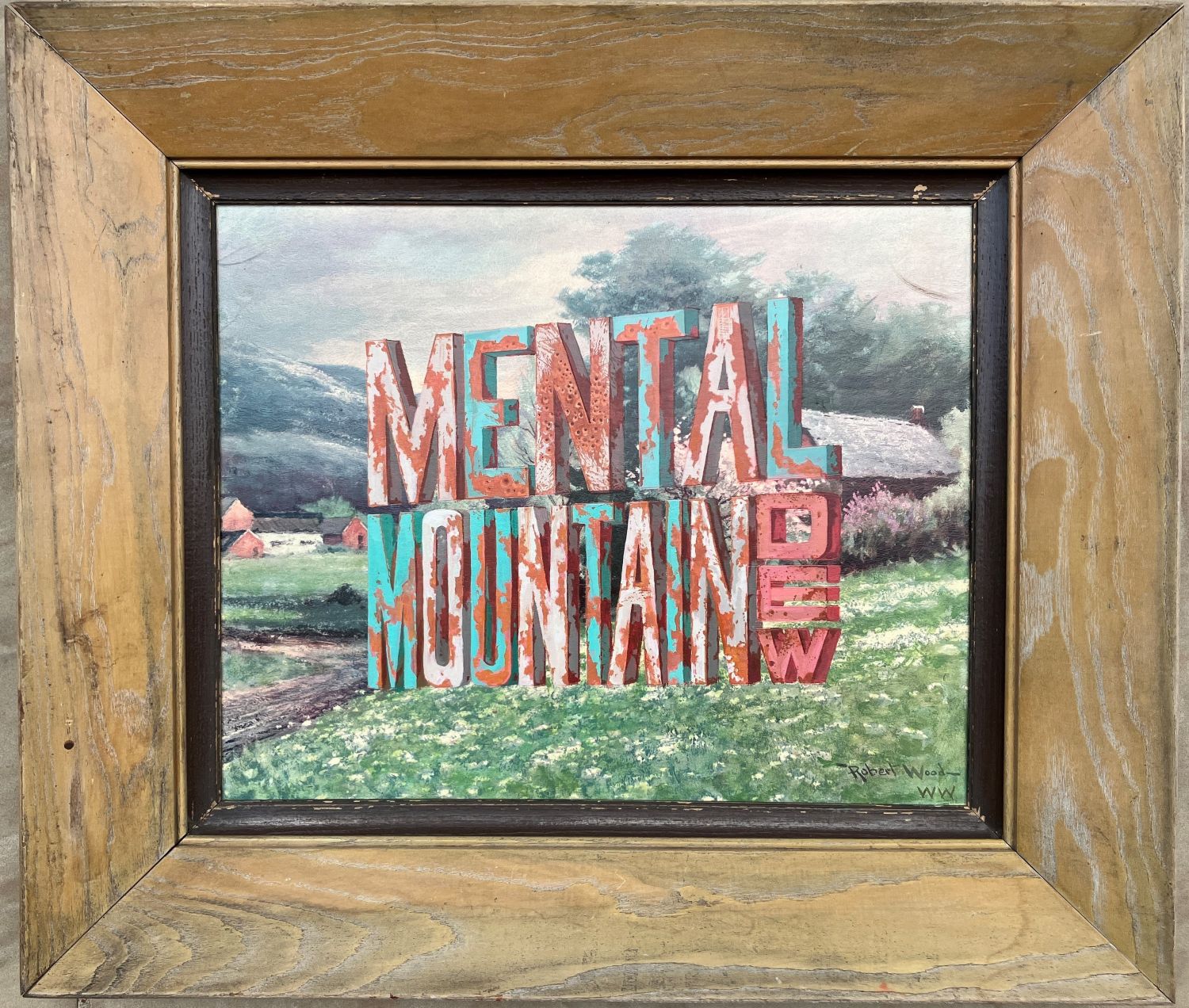
Wayne’s foray back into visual art grew out of reflections on his Southern identity and the “See Rock City” barns that were ubiquitous in his youth. As a result of Wayne’s musings, he decided to incorporate large, bold letters of text into his work.
“The first painting that I did, I was going to put the words on the side of a barn. And then I thought, ‘No, that’s too on the nose. I’ll just put them, like, in the landscape, like the Hollywood sign or something,’” he says.
Proceeding with a sense of whimsy, Wayne developed his line of “word paintings.” He began by painting over cheap landscapes purchased from thrift stores. Using these repurposed pieces, he painted humorous words, phrases, or sentences into their environments, giving them entirely new meanings.
According to Wayne, the overt use of humor by a visual artist is a rarity, as cultural tastemakers consider it lowbrow. “The fine art world is completely humorless. Curators, gallery owners, collectors, they all think they’re going to church,” he explains with a chuckle. “The humor in my art doesn’t get me into trouble, but it does prevent certain people from taking my work seriously.”
Many share Wayne’s sentiments, rejecting the notion that every painter must be brooding and melancholy à la Mark Rothko. Appreciating his contrarian spirit, early supporters and collectors emerged in the LA art scene and bought his work. Word began to spread about Wayne’s paintings, partly because nothing quite like it had been produced in recent memory.
“I took that approach because I wanted to stand out. Humor is a vital part of life. It’s our most important quality for existential survival. And yet, the art world doesn’t necessarily acknowledge it because it’s not part of the church ritual,” he says.
While Wayne’s work may have seemed heretical to the “orthodox” in the art world, its audience grew. At the same time, the scope of his work broadened, as his puppet shows became complex kinetic sculpture installations.
In 2012, Wayne received an extraordinary form of recognition for a visual artist: a feature-length documentary about his life entitled “Beauty Is Embarrassing.” This was yet another transformative experience for Wayne, and being the subject of a documentary is something he’s still pondering.
“I can’t believe that I was a figure who was so inspirational,” Wayne says pensively. “I never set out to be that. I never set out to be a self-help guru or an inspirational figure. But suddenly, that movie thrust me into that role...”
“And, for it to become a success on top of that, and to be still alive … people still send me emails and messages all the time about how they love that movie and how it changed their lives—that’s significant stuff.”
Pleased as Punch
Of course, an artist cannot rest on their laurels. Truth be told, if an artist does focus too much on public acclaim, they run the risk of losing their artistic focus. So the work must continue to evolve and grow as the artist explores their creative vision.
For Wayne, that evolution is continuing on a large scale. He is among the artists working on Meow Wolf Los Angeles, the immersive-art company’s forthcoming West Coast exhibition. For the project, he’s creating his own space, bringing together puppetry, painting, humor, and theatrical spectacle.
In case that blend of creativity sounds familiar, Meow Wolf has likened Wayne’s contribution to stepping into a surreal children’s-show dream. It’s fitting territory when one considers both Wayne’s career history and his free movement between painting, puppetry, television, performance, and installation art.
Even with a project of that scale underway, Wayne remains interested in exploring still more forms of expression. His creative work also continues through USERNAME PASSWORD, extending his output into music and live performance.
And there’s more! He explains, “Well, I’ve dabbled in the world of professional animation. I would love to get back into that somehow… I’ve been drawing since I was two years old. Animation and puppets are both appealing to me because it’s thrilling to see inanimate objects you’ve made come to life.”
Wayne also wants to break into the world of literature. “I’m a frustrated writer,” he says. “I keep journals, write poems, and I’ve even done some professional writing. I would love for that to be the next thing I tackle. I’m eventually going to write the story of my life as a collection of shorts. These would explore themes from my adventures in Hollywood, and there are many Southern themes that I’d like to explore.”
For further information about the work of Wayne White, visit his website and social media.